
Nickel Aluminium Bronze forged fittings have become a preferred material choice for demanding industrial environments such as marine, offshore, oil & gas and seawater handling systems. These industries require piping components that can operate reliably under continuous exposure to saltwater, high pressure, variable temperatures and aggressive operating conditions. Compared to conventional bronzes, brass and even some stainless steels, Nickel Aluminium Bronze (NAB) offers a unique combination of strength, corrosion resistance and long-term durability.
In this blog, we explain why Nickel Aluminium Bronze forged fittings are ideal for marine, oil & gas and seawater systems, and how they deliver superior performance in critical applications.
What Are Nickel Aluminium Bronze Forged Fittings?
Nickel Aluminium Bronze is a high-performance copper-based alloy primarily alloyed with aluminium, nickel and iron. The presence of nickel and iron significantly enhances the mechanical strength and corrosion resistance of the alloy, while aluminium contributes to the formation of a highly protective oxide layer on the surface.
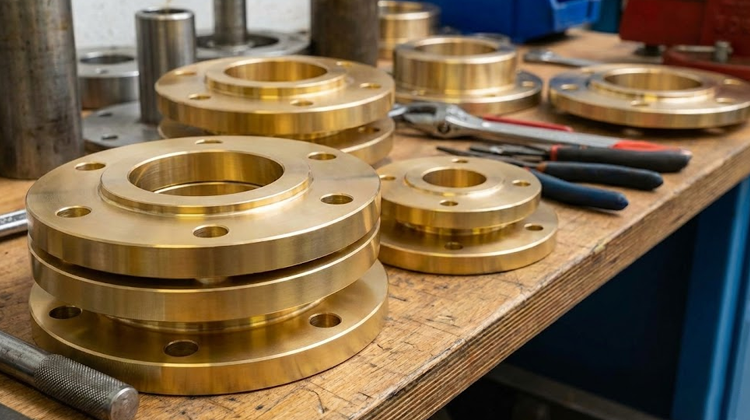
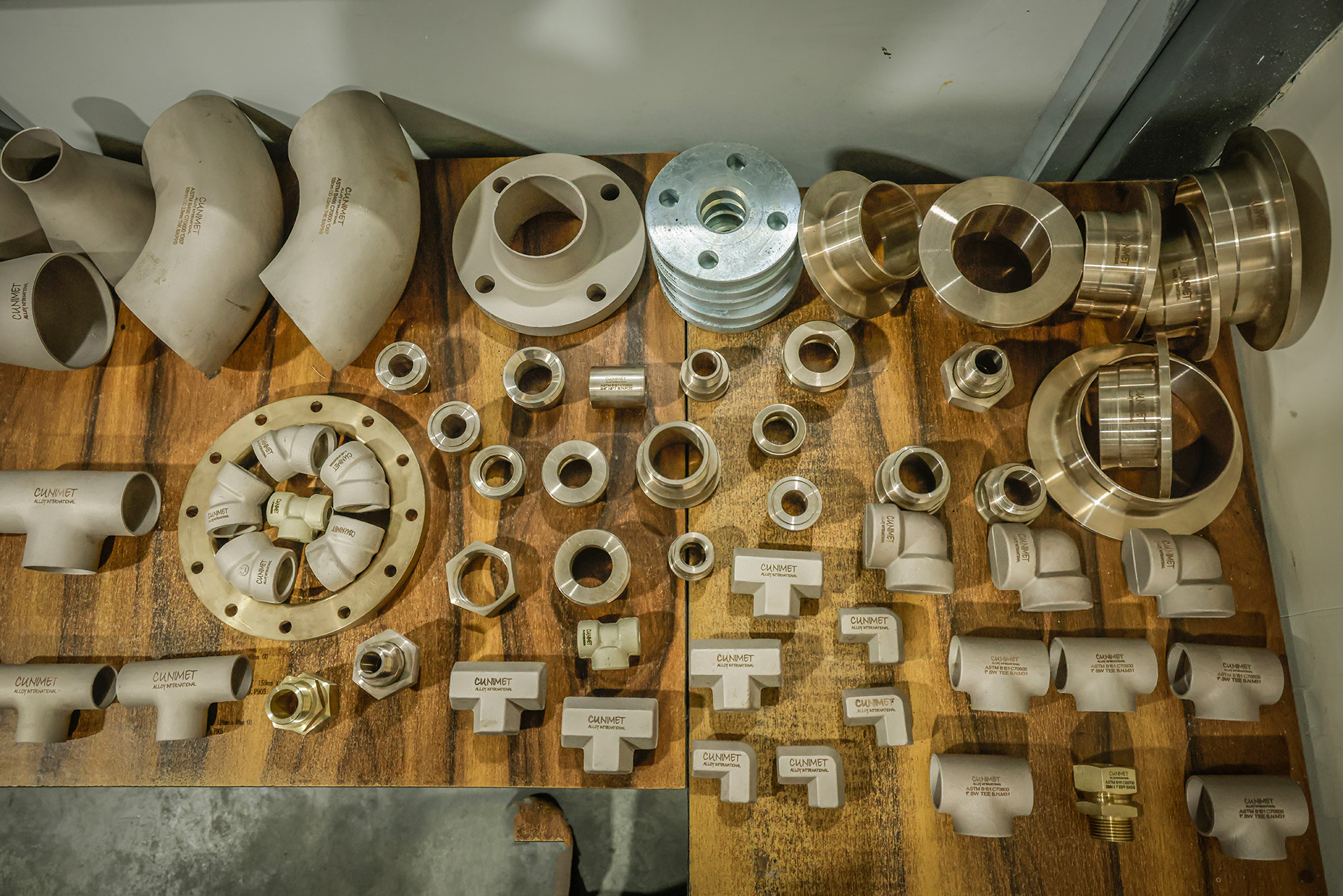
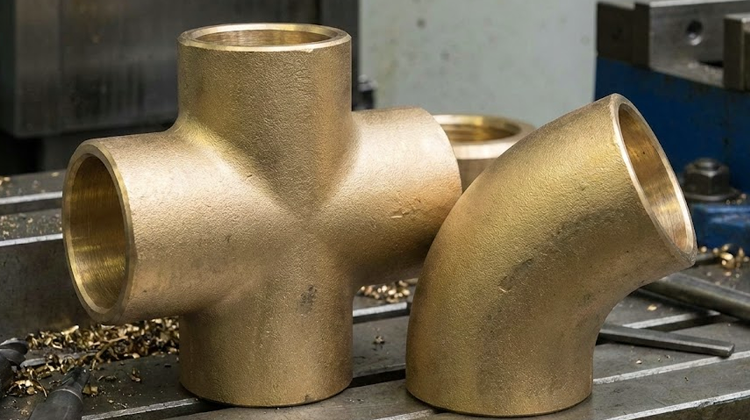
Forged fittings such as elbows, tees, couplings, unions, reducers, plugs and flanges are produced by hot forging followed by precision machining. This forging process results in a dense and refined grain structure, providing higher integrity, better impact resistance and superior pressure-handling capability compared to cast fittings.
Nickel Aluminium Bronze forged fittings are commonly supplied in grades such as UNS C63000, C63020, C63200 and C95510 and are manufactured in compliance with international standards like ASTM, ASME and relevant project specifications.
Excellent Resistance to Seawater Corrosion
One of the most critical challenges in marine and seawater systems is corrosion caused by chloride-rich environments. Nickel Aluminium Bronze forged fittings exhibit exceptional resistance to general corrosion, pitting and crevice corrosion in natural and artificial seawater.
The alloy forms a stable aluminium oxide film on the surface, which acts as a protective barrier against aggressive ions. This protective layer continuously regenerates itself, even when the surface is mechanically damaged. As a result, NAB forged fittings maintain dimensional stability and structural integrity over long operating periods in pipelines carrying seawater, cooling water and brine.
This makes Nickel Aluminium Bronze forged fittings highly suitable for applications such as:
- Seawater cooling systems
- Ballast water pipelines
- Fire-fighting and deluge systems
- Desalination plants and intake lines
High Resistance to Erosion and Cavitation
Marine and offshore piping systems often experience high flow velocities and turbulence, especially near pumps, valves and bends. Under such conditions, many metallic materials suffer from erosion-corrosion and cavitation damage.
Nickel Aluminium Bronze forged fittings provide outstanding resistance to erosion and cavitation due to their high hardness, strong microstructure and protective surface film. This property is especially valuable for elbows, tees and reducers installed in high-velocity seawater and hydrocarbon service lines.
As a result, NAB forged fittings help reduce material loss, unplanned shutdowns and costly replacement cycles in marine and offshore installations.
Superior Mechanical Strength for Oil & Gas Applications
Oil & gas facilities, both onshore and offshore, operate under high internal pressures, thermal fluctuations and mechanical stresses. Nickel Aluminium Bronze forged fittings offer excellent tensile strength, yield strength and fatigue resistance, enabling them to perform reliably in demanding process conditions.
The forging process further improves mechanical properties by eliminating internal porosity and producing a uniform grain flow aligned with the shape of the fitting. This significantly enhances pressure containment capability and impact resistance compared to cast fittings.
Because of these characteristics, Nickel Aluminium Bronze forged fittings are widely used in:
- Offshore production platforms
- Subsea piping systems
- Gas processing units
- Hydrocarbon transfer lines
- High-pressure pump and compressor connections
Outstanding Performance in Splash Zone and Aerated Seawater
Splash zones and highly aerated seawater environments are among the most aggressive conditions for metallic materials. These areas experience repeated wetting and drying, oxygen-rich water and temperature variation, which accelerate corrosion mechanisms.
Nickel Aluminium Bronze forged fittings perform extremely well in these environments due to their stable oxide film and resistance to localized attack. Unlike some copper alloys that may suffer from selective corrosion or dezincification, NAB maintains uniform corrosion behaviour and structural reliability.
This makes NAB forged fittings ideal for offshore topside piping, coastal installations, shipboard systems and seawater intake structures.
Natural Resistance to Biofouling and MIC
Biofouling and microbiologically influenced corrosion (MIC) are serious issues in marine and seawater pipelines. The accumulation of marine organisms and bacteria can restrict flow, increase pumping costs and initiate localized corrosion.
Nickel Aluminium Bronze possesses inherent resistance to marine organism attachment and bacterial activity. This reduces the formation of biological films on the internal surfaces of forged fittings and minimizes the risk of MIC-related failures.
By limiting biofouling, NAB forged fittings help maintain consistent flow performance and reduce maintenance and cleaning frequency in long-term service.
Improved Reliability Through Forged Construction
The manufacturing method plays a vital role in the performance of piping components. Forged fittings offer significantly higher reliability than cast fittings, especially for safety-critical applications.
Nickel Aluminium Bronze forged fittings provide:
- Dense, non-porous structure
- Consistent mechanical properties throughout the section
- Better resistance to crack initiation and propagation
- Improved dimensional accuracy after machining
This makes forged NAB fittings particularly suitable for pressure systems and critical process lines in oil & gas and marine installations where operational failure can lead to major safety and environmental consequences.
Non-Sparking and Wear-Resistant Properties
Safety is a key concern in hydrocarbon processing and offshore environments. Nickel Aluminium Bronze is a non-sparking material, making it suitable for use in potentially explosive atmospheres.
In addition, NAB forged fittings offer good wear resistance and galling resistance when used with compatible mating materials. This property is beneficial in systems involving frequent vibration, mechanical movement or high-flow erosion conditions.
Common Grades and Specifications Used in Marine and Oil & Gas Projects
Several Nickel Aluminium Bronze grades are commonly specified for forged fittings depending on project requirements, operating conditions and governing standards. Typical grades include:
- UNS C63000
- UNS C63020
- UNS C63200
- UNS C95510
In specialized and defence-related projects, Nickel Aluminium Bronze components may also be produced to meet specific AMS material standards such as AMS 4640 and AMS 4881, where enhanced mechanical and quality requirements are required.
Typical Nickel Aluminium Bronze Forged Fittings Supplied
Nickel Aluminium Bronze forged fittings are available in a wide range of configurations, including:
- 45° and 90° elbows
- Equal and reducing tees
- Straight and reducing couplings
- Unions and nipples
- Threaded and socket weld fittings
- Blind, threaded and slip-on flanges
- Square plugs, hex plugs and bushings
These fittings are manufactured in accordance with ASME, ASTM and project-specific specifications to ensure compatibility with global piping systems.
Long Service Life and Reduced Total Cost of Ownership
Although Nickel Aluminium Bronze forged fittings may have a higher initial cost compared to standard copper alloys or carbon steel, they offer significantly lower life-cycle costs. Their resistance to corrosion, erosion, biofouling and mechanical damage reduces maintenance requirements, inspection frequency and replacement intervals.
For marine and offshore operators, this translates into improved operational uptime, enhanced safety and reduced long-term expenditure.
Nickel Aluminium Bronze forged fittings are ideal for marine, oil & gas and seawater systems because they combine excellent corrosion resistance, outstanding erosion and cavitation performance, high mechanical strength and superior reliability through forged construction. Their ability to perform consistently in aggressive chloride-rich environments, splash zones and high-pressure process systems makes them a trusted material choice for critical piping infrastructure.
By using proven grades such as UNS C63000, C63020, C63200 and C95510, and manufacturing forged fittings in compliance with international standards, project owners and engineering contractors can achieve long-term performance, safety and cost efficiency in even the most challenging operating conditions.
Related Posts
Phosphor Bronze – Properties, Grades, Applications and Advantages
Banter! Could “workplace banter” cause problems in your business? The short answer? Yes.